📘 AP World History: Modern — In-Depth Course Overview
🧭 The Course at a Glance
AP World History: Modern is organized into nine units that trace how states, economies, belief systems, and people moved around a connected globe from c. 1200 CE to the present. The through-lines to watch:
- State-building — how rulers legitimize and consolidate power (religion, art, bureaucracy, military, taxation).
- Networks of exchange — how trade, technology, and disease spread through the Silk Roads, Indian Ocean, Trans-Saharan, and later transoceanic routes.
- Labor systems — corvée, slavery (Atlantic chattel slavery), encomienda/hacienda, serfdom, wage labor, indentured servitude.
- Cultural and religious diffusion — Islam, Christianity, Buddhism, Neo-Confucianism, Hinduism; syncretic religions; Enlightenment ideas.
- Technology & environment — gunpowder, maritime tech, steam, electricity, fossil fuels, Green Revolution, climate change.
- Revolution & resistance — Atlantic Revolutions, nationalist movements, anti-colonial movements, civil rights, feminism, environmentalism.
| Unit | Title | Dates | Core question |
|---|---|---|---|
| 1 | The Global Tapestry | c. 1200–1450 | How did states across Afro-Eurasia and the Americas build and justify power? |
| 2 | Networks of Exchange | c. 1200–1450 | How did trade routes reshape economies, cultures, and environments? |
| 3 | Land-Based Empires | c. 1450–1750 | How did gunpowder empires consolidate and legitimize rule? |
| 4 | Transoceanic Interconnections | c. 1450–1750 | How did maritime empires and the Columbian Exchange remake the world? |
| 5 | Revolutions | c. 1750–1900 | How did Enlightenment ideas and industrialization transform societies? |
| 6 | Consequences of Industrialization | c. 1750–1900 | How did industrial power drive imperialism, migration, and resistance? |
| 7 | Global Conflict | c. 1900–present | How did empires fall, world wars reshape states, and mass atrocity occur? |
| 8 | Cold War & Decolonization | c. 1900–present | How did ideology, proxy wars, and independence movements reorder the world? |
| 9 | Globalization | c. 1900–present | How did technology, free-market economics, and culture globalize — and who resisted? |
🎯 Historical Thinking Skills & Reasoning Processes
1. Developments & Processes
Identify and explain historical developments and processes.
2. Sourcing & Situation (HIPP)
Historical situation, Intended audience, Purpose, Point of view — and how they shape a source.
3. Claims & Evidence in Sources
Identify claims; explain how evidence supports, qualifies, or modifies them.
4. Contextualization
Situate developments in broader regional, national, or global contexts.
5. Making Connections
Across time, place, and theme — Comparison, Causation, or CCOT.
6. Argumentation
Develop a historically defensible claim with a clear line of reasoning, evidence, and complexity.
🌶️ SPICE-T Themes (your SPICE Review.docx)
| Letter | Theme | What to track |
|---|---|---|
| S | Social | Stratification (class, caste, race, gender), family, how groups interact. Examples: caste India, serfdom, casta Americas, industrial middle class. |
| P | Political | Govt structures, nations & nationalism, revolts/revolutions, regional + global orgs. Examples: Song bureaucracy, Tokugawa, UN, EU. |
| I | Interaction w/ Environment | Demographics, disease, migration, settlement, tech. Examples: Black Death, Columbian Exchange, Green Revolution. |
| C | Cultural | Religion, tolerance, intellectual & artistic achievement, language, science. Examples: Sufism, Renaissance, Enlightenment, négritude. |
| E | Economic | Labor systems, tech/industry, systems (capitalism/communism), trade, standards of living. Examples: mercantilism, chattel slavery, indentured servitude, globalization. |
| T | Technology | Communication, transport, military, agricultural, medical tech. Examples: astrolabe, steam engine, telegraph, internet. |
🗓️ Periodization — from your Completed Course Chart
🗺️ AP World Regions (match the CED map)
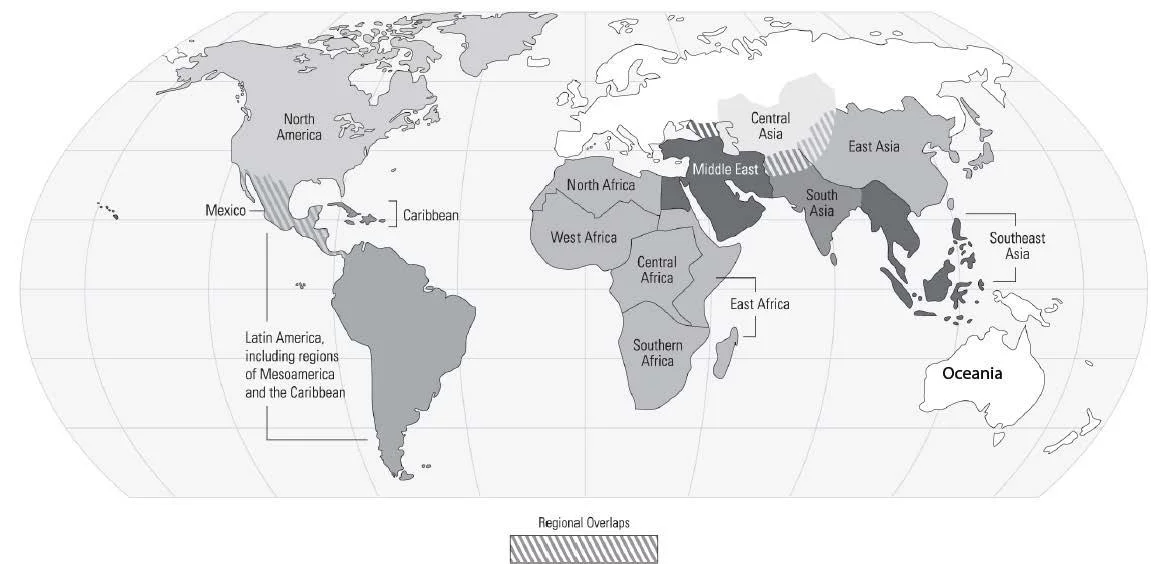
ap+world+regions+map.jpg.webp in the same folder as this HTML.Regions you must be able to locate
- East Asia: China, Korea, Japan, Mongolia, Taiwan.
- Southeast Asia: Vietnam, Thailand, Cambodia, Laos, Myanmar, Malaysia, Indonesia, Philippines.
- South Asia: India, Pakistan, Bangladesh, Sri Lanka, Nepal, Bhutan.
- Central Asia: the "-stans," Afghanistan, Tibet.
- Southwest Asia / Middle East: Arabia, Persia/Iran, Anatolia/Turkey, Levant.
- North Africa: Egypt, Maghreb.
- Sub-Saharan Africa: West (Mali, Ghana, Songhai), East (Swahili, Ethiopia), Central, Southern (Great Zimbabwe).
- Europe: Western, Central, Eastern, Russia.
- Americas: North (incl. Mesoamerica), South (Andes, Amazon), Caribbean.
- Oceania: Australia, NZ, Pacific islands.
🟨 Unit 1 · The Global Tapestry (c. 1200–1450)
🏷️ Key Terms · click any term for a short definition
Big Picture
State-building and cultural developments across Afro-Eurasia and the Americas before the global age. You must be able to compare state structures across regions and explain how belief systems legitimized power.
Key States & Societies
- East Asia: Song China (Neo-Confucianism, meritocratic exam, foot-binding, champa rice, paper money, gunpowder, movable type); tributary system with Korea (Goryeo), Japan (Heian → Kamakura shogunate + feudalism + bushidō), Vietnam.
- Dar al-Islam: Abbasid decline → Seljuk & Mamluk Turks, Delhi Sultanate; House of Wisdom, al-Khwarizmi/algebra, Ibn Battuta, Ibn Khaldun, Sufism spreads Islam peacefully.
- South & SE Asia: Delhi Sultanate, Vijayanagara (Hindu), Rajput kingdoms; Srivijaya (Buddhist, maritime) → Majapahit (Hindu) → Malacca (Muslim); Khmer Empire (Angkor Wat → Angkor Thom).
- Americas: Mississippian (Cahokia, mounds), Mayan city-states (decline, but cultural continuity), Aztec/Mexica (chinampas, tribute empire, Tenochtitlán), Inca (mit'a labor, Quipu, terrace farming, Sapa Inca).
- Africa: Great Zimbabwe, Hausa city-states, Mali Empire (Mansa Musa 1324 hajj, Timbuktu/Sankore), Ethiopia (Christian), Swahili Coast (Swahili = Bantu + Arabic, Indian Ocean trade).
- Europe: Feudalism, manorialism, Holy Roman Empire, Catholic Church power, Great Schism 1054 (Catholic v Orthodox), Crusades, growth of universities; Mongol Yoke on Kievan Rus.
Religions & Cultures
- Islam spreads peacefully via trade/Sufis; Hinduism & Buddhism coexist in S/SE Asia; Neo-Confucianism in Song synthesizes Confucian + Buddhist/Daoist ideas; Christianity splits.
- Syncretism: Sikhism emerges later, but watch for Swahili (Bantu+Islam) and Aztec religion absorbing conquered peoples' gods.
Must-know terms
Tips
Heimler Review Guide — Deep Dive (Unit 1)
🇨🇳 China: The Song Dynasty (960–1276 CE)
- What is a state? An organized political community under one government (country, empire, nation). State-building and maintaining the state is the master theme of Unit 1.
- How did the Song maintain and justify rule? Revival of Confucianism as Neo-Confucianism legitimized the dynasty by leaning on ancient Chinese tradition. An imperial bureaucracy — staffed through the Civil Service Exam on the Confucian classics — administered the empire.
- Confucian social order: hierarchical (state over citizens, men over women). Harmony depends on keeping the proper relationships. Filial piety: children honor parents, grandparents, ancestors. Confucianism + bureaucracy were continuities from Han and Qin dynasties — Neo-Confucianism was the innovation.
- Women in Song China: subordinate legal status. Women couldn't own property or remarry; elite women's feet were bound. Limited access to education.
- Influence on neighbors (tributary system): Korea adopted a civil service exam and Buddhism; Japan and Vietnam absorbed Confucian and Buddhist practices.
- Buddhism refresher: Four Noble Truths (life contains suffering; cause is desire); Eightfold Path ends it; goal is to escape reincarnation and reach nirvana. Theravada (original; monastic, SE Asia). Mahayana (East Asia; bodhisattvas help others). Tibetan/Vajrayana is a third branch.
- Song economy: inherited Sui/Tang growth; population doubled 8th–10th c. Commercialization of silk and porcelain; free peasant and artisan labor. Expanded Grand Canal. Centers of iron and steel production.
- Champa rice (from Vietnam via tribute system, 8th–11th c.): drought-resistant, early-maturing → two harvests/year → food surplus → population explosion.
🕌 The Middle East: Abbasid Caliphate & Turkic States
- Abrahamic connection: Islam, Judaism, and Christianity are all monotheistic. Muhammad claimed to be the final prophet in a line that goes back through Jewish and Christian scripture. All three coexisted in Dar al-Islam.
- Abbasid decline: already breaking up by 1200; Mongols sacked Baghdad in 1258, ending the caliphate.
- New Turkic Muslim states (not Arab): the Seljuks were Central Asian Turks the Abbasids tried to use as mercenaries — instead they built their own empire. Other Turkic Muslim states: the Delhi Sultanate (South Asia) and the Mamluk Sultanate of Egypt (founded by slave soldiers).
- Borrowed from earlier empires: Sharia (legal code from the Quran).
- Intellectual innovations: Nasir al-Din al-Tusi invented trigonometry. The House of Wisdom in Baghdad preserved Greek philosophy (Plato, Aristotle), translating it into Arabic — later re-transmitted to Europe, helping spark the Renaissance.
- How Islam expanded: military conquest (Seljuks, Mamluks, Delhi Sultanate), merchants (Mali), and Sufi missionaries who allowed for local belief and spread Islam peacefully.
🛕 South & Southeast Asia
- South Asia religions: Hinduism (majority), Islam (elite after Delhi Sultanate), Buddhism (mostly monastic by 1200). Bhakti Hinduism emerged in southern India — devotional worship of one god that challenged social and gender hierarchies.
- Southeast Asia: Buddhism dominates in Thailand and Cambodia; Islam spreads more widely through maritime trade.
- New states & how they ruled:
- Delhi Sultanate (northern India, Muslim rulers over Hindu majority).
- Rajput kingdoms — warring Hindu kingdoms who blocked Delhi expansion.
- Vijayanagara — Hindu empire founded by brothers who had converted to Islam while serving Delhi, then reconverted to Hinduism and rivaled Delhi.
- Majapahit (Java) — Buddhist; controlled sea trade routes, declined when China backed rival Malacca.
- Khmer Empire — began Hindu, leaders adopted Buddhism. Angkor Wat reflects both faiths.
- Pattern: merchants from South Asia brought Hinduism, Buddhism, and Islam to SE Asia; local governments adopted these religions to strengthen trade relationships and legitimize rule.
🏛️ State Building in the Americas
- Aztec/Mexica (founded 1345, capital Tenochtitlán): huge empire after 1428 expansion; decentralized rule. Control mechanism: conquered people paid tribute in goods or labor, were enslaved, and were sometimes sacrificed.
- Inca (Andean region): centralized bureaucracy. Mit'a system required labor service on state farms, mines, military, and construction projects.
- Mississippian (North America, Mississippi River valley): agriculture-based; larger towns controlled smaller ones. Known as mound builders; the Cahokia built 80 burial mounds, some up to 100 feet tall.
- Takeaway: Americas show independent innovation and diversity of state systems — decentralized tribute-collecting empire (Aztec) vs. highly centralized labor-based empire (Inca) vs. agricultural chiefdom (Mississippian).
🌍 State Building in Africa
- Swahili city-states (East Africa): politically independent but culturally shaped by Dar al-Islam through Indian Ocean trade. Swahili language = Bantu grammar + Arabic vocabulary.
- West Africa — Ghana, Mali, Songhai: highly centralized. Elites converted to Islam; most subjects kept indigenous beliefs. Mansa Musa's 1324 hajj displayed Mali's wealth and cemented its place in Dar al-Islam; he patronized Timbuktu and the Sankore University.
- Hausa kingdoms (West Africa): decentralized city-states, culturally linked, wealthy as brokers of trans-Saharan trade.
- Great Zimbabwe (Southern Africa): massive stone capital 1250–1450, population ~18,000. Wealth from gold trade, farming, and cattle. Unlike neighbors, rulers kept their indigenous shamanistic faith rather than adopting Islam.
- Ethiopia: grew through Mediterranean/Arabian trade; monarchy + strict hierarchy — but Christian (Ethiopian Orthodox) rather than Muslim.
⛪ Developments in Europe
- Religions: Western Europe = Roman Catholic (the Church held society together culturally after Rome's fall); Eastern Europe + Byzantine Empire = Orthodox Christian (Kievan Rus adopted Orthodoxy in 988). Muslims in the Iberian Peninsula after the 8th-century conquest. Jews faced waves of anti-Semitism.
- Feudalism: decentralized political system. Kings → great lords → lesser lords (vassals) → knights. Vassals received fiefs (land) in exchange for military service.
- Manorialism & serfdom: the economic flip-side. Serfs were peasants bound to the land in exchange for a lord's protection. Not property like slaves, but could not leave without permission.
📖 AMSCO Readings & Key Videos by Topic
Topic 0.0 Essentials of History
Topic 1.1 East Asia (Song)
Topic 1.2 Dar al-Islam
Topic 1.3 South & SE Asia
Topic 1.4 State Building in the Americas
Topic 1.5 State Building in Africa
Topic 1.6 Europe
Topic 1.7 Comparison c. 1200-1450
🟧 Unit 2 · Networks of Exchange (c. 1200–1450)
🏷️ Key Terms · click any term for a short definition
Three Big Trade Networks
- Silk Roads (land): luxury goods (silk, porcelain, spices); caravanserai; paper money (flying cash), banking houses; revived by Mongol Pax Mongolica.
- Indian Ocean (sea): monsoon winds, dhow & junk ships, magnetic compass, astrolabe, lateen sail; diasporic communities (Arab in Swahili, Chinese in Malacca); Zheng He voyages (1405–33).
- Trans-Saharan (sand): camel + saddle, caravan, gold-salt trade; Mali/Songhai; spread of Islam in West Africa.
Mongols
- Genghis Khan unites steppe; Khanates: Yuan (China), Chagatai, Ilkhanate (Persia), Golden Horde (Russia).
- Effects: Pax Mongolica → revived Silk Roads, cultural exchange (gunpowder, printing flow west), Black Death vector; destruction of Abbasid Baghdad 1258.
Consequences of Networks
- Growth of trading cities: Hangzhou, Samarkand, Kashgar, Calicut, Melaka/Malacca, Kilwa, Timbuktu, Venice, Novgorod.
- Diffusion: Indian numerals, Champa rice, gunpowder, compass.
- Travelers: Marco Polo, Ibn Battuta, Margery Kempe, Rabban Bar Sauma.
- Environmental: Black Death (1347–51, ½–⅓ European deaths), labor shortages → end of serfdom in W. Europe.
Must-know terms
Tips
Heimler Review Guide — Deep Dive (Unit 2)
🛤️ The Silk Roads
- "Networks of exchange" is another way to say trade routes. Between c. 1200 and c. 1450, they expanded due to new commercial practices and trade technology — leading to growth of states and trading cities across Afro-Eurasia.
- What was traded on the Silk Road? Mostly luxury goods: Chinese silk, porcelain, jade. Long, expensive journeys meant only high-margin goods were worth it.
- Effect of demand: Chinese, Persian, and Indian artisans scaled up production. Chinese farmers even shifted from food to silk production. Iron and steel output also rose.
- Transportation innovations: caravanserai — inns a day's travel apart where merchants rested, stored goods safely, and mingled across cultures.
- Commercial practices:
- Paper money in China — easier than carrying coin.
- Flying Cash — deposit money in one location, withdraw the same amount in another (early banking).
- European banking houses issuing bills of exchange — basically checks.
- Cities grew along the routes: Kashgar, at the junction of two major Silk Road branches, became wealthy and powerful.
🌊 The Indian Ocean Network
- Monsoon winds blew predictably one direction, then the other, at known times of year — this made travel times plannable and made Indian Ocean commerce possible.
- Technology: improved magnetic compass (direction), improved astrolabe (latitude), new ship designs like the Chinese junk (big cargo hold), Arab dhow, and the lateen sail (sailing into the wind).
- Goods: bulk goods — textiles, spices — because ship hulls hold a lot. Luxury goods still traded too.
- City growth: East African Swahili city-states became major ports linked to Dar al-Islam. Arab and Persian merchants married African women, forming diasporic communities — producing the Swahili language and the spread of Islam.
- Zheng He (Ming Dynasty admiral, 1405–1433): sailed the Indian Ocean to expand China's tributary system. Voyages transferred Chinese navigation, shipbuilding, and culture to the places he visited. Voyages ended in 1433.
🐫 Trans-Saharan Networks
- Technology: improved camel saddles made it possible to carry larger cargo across the Sahara.
- Mali grew rich by connecting to Dar al-Islam, trading gold, and taxing trans-Saharan routes. Mansa Musa monopolized trade routes — his wealth is visible in his 1324 hajj.
🔄 Consequences of Connectivity
- Religious diffusion: Islam and Hinduism spread into Southeast Asia; Buddhism spread from South Asia to China along the Silk Roads via merchants and missionaries.
- Literary/artistic transfer: Greek and Roman works preserved in Arabic at Baghdad's House of Wisdom were re-transmitted to Europe — helping trigger the Renaissance.
- Most significant technological transfer: gunpowder, traveling from China westward through Muslim and Mongol intermediaries. Paper and printing also spread.
- City growth & decline: Hangzhou (end of the Grand Canal) boomed. Baghdad collapsed in 1258 when the Mongols sacked it.
- Travelers: Ibn Battuta — Muslim scholar from Morocco who traveled Dar al-Islam for 30 years, leaving a detailed record. Marco Polo inspired generations of Europeans to look east. Margery Kempe (English Christian mystic) is another named traveler.
- Environmental effects:
- Champa rice into China → population boom.
- Bubonic plague (Black Death) traveled the Silk Roads from China to the Middle East and Europe — killing up to ½ of Europe's population.
🏹 The Mongol Empire
- Why covered in Unit 2 not Unit 1: the Mongols' most lasting importance is that their enormous empire facilitated the trade and exchange of this era.
- Political impact: largest land empire ever. Ended the Song dynasty (Yuan replaces it) and the Abbasid caliphate. Ruled through Khanates: Yuan (China), Chagatai, Ilkhanate (Persia), Golden Horde (Russia).
- Why trade flourished under the Mongols: they paid high prices for foreign goods and kept the Silk Road safe — this is the Pax Mongolica.
- Cultural/technological transfers via Mongols: Greek and Islamic medical knowledge flowed to Western Europe; Mongols adopted the Uyghur script for their written language.
📖 AMSCO Readings & Key Videos by Topic
Topic 2.1 The Silk Roads
Topic 2.2 Mongol Empire
Topic 2.3 Indian Ocean
Topic 2.4 Trans-Saharan
Topic 2.5 Cultural Consequences
Topic 2.6 Environmental Consequences
Topic 2.7 Comparison of Exchange
🟥 Unit 3 · Land-Based Empires (c. 1450–1750)
🏷️ Key Terms · click any term for a short definition
The Big 5 Land-Based / Gunpowder Empires
| Empire | Religion | Consolidation tool |
|---|---|---|
| Ottoman (1299–1922) | Sunni Islam | Devshirme → Janissaries, millet system |
| Safavid (1501–1736) | Shi'a Islam | Shi'ism as state identity; Qizilbash |
| Mughal (1526–1857) | Sunni Islam (Hindu majority) | Akbar's tolerance, Zamindars, jizya (on/off) |
| Ming (1368–1644) | Confucian | Exam bureaucracy, Great Wall, Forbidden City |
| Qing (1644–1912) | Confucian (Manchu) | Queue, banner system, Kangxi & Qianlong expansion |
Also: Tsarist Russia, Tokugawa Japan
- Romanovs: Ivan IV "the Terrible," Peter the Great (Westernization), Catherine the Great. Serfdom expands.
- Tokugawa Japan: sakoku isolation, daimyo controlled via sankin-kōtai, four-tier class system.
- Europe: Absolutism (Louis XIV, Versailles, divine right) and constrained monarchy (English Civil War → Glorious Revolution 1688, English Bill of Rights).
Legitimizing & Administering Power
- Art/architecture: Versailles, Topkapi, Taj Mahal, Isfahan's Shah Mosque, Forbidden City, Suleymaniye.
- Bureaucracy: zamindars (Mughal), jagir; janissaries; devshirme; millet; Qing banner system.
- Tax systems: tax farming (Ottoman), mit'a (Spanish Andes), tribute (Aztec, Qing).
- Religion as legitimacy: "shadow of God on earth" (Ottoman), divine right (Louis XIV), Shi'a messianism (Safavid), Son of Heaven (Ming/Qing).
Cultural & Religious Developments
- Protestant Reformation (Luther 1517, 95 Theses) → Calvinism, Anglicanism. Counter-Reformation (Council of Trent, Jesuits).
- Sikhism founded by Guru Nanak in Punjab — blends Islam + Hinduism.
- Sunni–Shi'a split politicized by Ottoman–Safavid rivalry.
- Scientific Revolution beginnings (Copernicus, Galileo, Newton) feed into U4.
Must-know terms
Tips
Heimler Review Guide — Deep Dive (Unit 3)
🔫 Gunpowder Empires Expand
- Ottomans: gunpowder weapons helped conquer Anatolia and SE Europe; took Constantinople in 1453, renaming it Istanbul. Enslaved Christian boys from the Balkans via the Devshirme system — converted to Islam, trained, turned into the elite Janissary infantry.
- Safavids: raided neighbors using gunpowder; Shah Abbas built a military with a slave army drawn from Caucasus Christians.
- Mughals: Babur defeated the Delhi Sultanate with gunpowder → Mughal expansion in South Asia. Akbar legitimized rule by tolerating the Hindu majority.
- Ottoman-Safavid rivalry: Sunni Ottomans vs. Shi'a Safavids. Split began as a political divide over Muhammad's successor; intensified with both sides claiming to be the true Islam.
- Safavid-Mughal conflict: fought over Afghan territory. The Mughals (Sunni) couldn't retake lands seized by the Safavids (Shi'a).
🏛️ Administering Empires — Legitimize & Consolidate
- Legitimizing = establishing authority to rule. Consolidating = transferring power from other groups to yourself.
- Bureaucracies: thousands of government officials enforcing law across the empire. The Ottoman Devshirme produced loyal bureaucrats and Janissaries from enslaved Christian boys — educated in Istanbul, promoted on merit, bypassing aristocratic rivals.
- Religious legitimacy — Europe: the Divine Right of Kings taught that monarchs were God's representatives. Rebelling against the king meant rebelling against God.
- Art as legitimacy — Qing: as Manchus (ethnic minority) ruling Han Chinese, the Qing portrayed themselves in portraits with books — signaling Confucian wisdom to appeal to Han subjects.
- Monumental architecture:
- Inca Sun Temple of Cuzco — gold-covered walls; rulers linked to gods.
- Versailles (Louis XIV) — showed royal power; forced French nobility to live there so the king could monitor them, stripping their local power.
- Innovative tax collection:
- Zamindar system (Mughal): elite landowners taxed peasants for the emperor — eventually became corrupt.
- Tax farming (Ottoman): sold the right to collect taxes to private parties.
- Tribute lists (Aztec): conquered regions paid a prescribed list of goods.
✝️ Belief Systems in Empires
- Change in Christianity: the Catholic Church grew corrupt — simony (buying church offices), selling indulgences (paying to be forgiven). Martin Luther's 95 Theses (1517), spread by the printing press, started the Protestant Reformation.
- Catholic response: the Council of Trent reformed church corruption but kept core doctrines.
- Sunni-Shi'a split hardens: Shah Ismail declared the Safavid Empire a Shi'a state; Sunnis executed; armies cursed the first three Sunni caliphs. Religious difference became a pretext for war.
- Sikhism: founded by Guru Nanak in Punjab as a syncretic blend of Hindu + Islam. Adopted monotheism from Islam and reincarnation from Hinduism. Rejected caste and gender hierarchy — radical equality.
📖 AMSCO Readings & Key Videos by Topic
Topic 3.1 Empires Expand
Topic 3.2 Empires: Administration
Topic 3.3 Empires: Belief Systems
Topic 3.4 Comparison in Land-Based Empires
🟪 Unit 4 · Transoceanic Interconnections (c. 1450–1750)
🏷️ Key Terms · click any term for a short definition
Maritime Tech + Exploration
- Inventions combined: caravel (Portugal), carrack, fluyt (Dutch); astrolabe + compass + lateen sail; new maps (Mercator 1569).
- Motives: God, Gold, Glory + Ottoman control of overland routes → search for sea route to Asian spices.
- Portuguese (da Gama, Henry the Navigator, trading-post empire Indian Ocean) → Spanish (Columbus, Magellan, Aztec/Inca conquest) → Dutch (VOC 1602) → English/French.
Columbian Exchange
- To Americas: horses, cattle, pigs, sugar, wheat, smallpox, measles, influenza.
- To Eurasia/Africa: maize, potato, tomato, cassava, tobacco, cacao → population boom (esp. China, Europe).
- Indigenous demographic catastrophe (up to 90% loss) → African slave labor imported.
Labor Systems & Societies
- Atlantic slave trade: ~12.5 million Africans → Americas 1501–1866; Middle Passage; plantation/chattel slavery.
- Encomienda → Hacienda (Spanish); Mit'a retooled for silver mines (Potosí).
- Casta system: peninsulares → criollos → mestizos → mulattoes → Africans → Indigenous.
- Resistance: maroon communities, Stono Rebellion 1739, Haitian Revolution seeds.
Trade & Economics
- Mercantilism: bullionism, favorable balance, Navigation Acts; chartered joint-stock companies (VOC, BEIC).
- Silver trade: Potosí + Japan → China (required silver for taxes per Single-Whip law) → global trade loop.
- Sugar, tobacco, cotton plantations; Triangular trade.
- Rise of banking, insurance, stock exchanges (Amsterdam 1602).
Cultural / Intellectual
- Scientific Revolution: Copernicus, Kepler, Galileo, Newton (Principia, 1687) — empiricism + math.
- Syncretism: Vodun (Haiti), Santería (Cuba), Candomblé (Brazil) — African + Catholic.
- Renaissance → Baroque art; printing press spreads Reformation + science.
Must-know terms
Tips
Heimler Review Guide — Deep Dive (Unit 4)
⛵ Causes of European Exploration
- Technology adopted from others:
- Magnetic compass — from China.
- Astrolabe — from Ancient Greece & the Arab world; used for latitude.
- Lateen sail — from the Arab world; cuts through the wind.
- European shipbuilding innovation: the Portuguese caravel — fast, shallow-draft, could navigate rivers and coasts.
- Wind patterns in the Atlantic were a huge obstacle until seasonal patterns were mapped; once understood, Europeans could sail south of the equator and round Africa.
- Political cause: growth of state power. European monarchs centralized authority, weakened the nobility, and could sponsor transoceanic exploration.
- Economic cause: nobles still demanded Asian spices, but overland costs had soared — cut out the middleman.
- Mercantilism: theory that world wealth is finite; each state competes for the largest share of gold/silver. Goal: favorable balance of trade (export more than you import). Colonies exist to enrich the parent country.
- Joint-stock companies: limited-liability businesses chartered by states but funded by private investors. Spread risk across many investors — made long voyages financially viable. The Dutch East India Company (VOC) chartered in 1602 dominated Indian Ocean trade.
🌍 Establishing Maritime Empires
- Portugal: Prince Henry the Navigator assembled sailors, mapmakers, shipbuilders. Sailed down Africa's Atlantic coast to reach West African gold, then round to the Indian Ocean. Built a trading-post empire (called "factories") rather than territorial colonies — relied on caravels and gunpowder.
- Spain: sponsored Columbus to find a western route to Asia; instead found the Americas. Colonized the Americas and the Philippines, using tribute and coerced labor.
- France: looked for a North Atlantic route to Asia. Didn't find it, but established a fur-trade presence in Canada. Focused on trade, not territorial colonies.
- England: started with failed Roanoke, then successful Jamestown (1607). Also began trade in India but was not yet strong enough to defeat the Mughals.
- Dutch: after independence from Spain, the VOC broke into Portuguese/Spanish Indian Ocean networks. Settled New Amsterdam (later New York). Eventually monopolized the Indian Ocean spice trade.
🌽 The Columbian Exchange
- Definition: transfer of diseases, food, plants, and animals between the Eastern and Western hemispheres. It's an environmental phenomenon, not pure trade.
- Diseases to the Americas: smallpox, measles, malaria. Indigenous populations had no immunity → ~90% mortality — the Great Dying.
- Foods to the Americas: wheat, olives, grapes (Europe); rice, bananas, sugar (Africa/Asia). Diet diversification slowly increased lifespans.
- Foods to Afro-Eurasia: maize and potatoes → healthier populations and a population explosion after 1700.
- African foods to the Americas: okra and rice — sometimes braided into children's hair during kidnappings as survival seed.
- Animals to the Americas: pigs, sheep, cattle, horses — used for agriculture and hunting.
- Cash cropping: farmers specialize in a single crop for export (sugar in the Caribbean grown by enslaved Africans for Europe/Middle East). Typically done on plantations with coerced labor.
- Japan resists: Tokugawa shoguns feared Japanese Christian converts. Kicked out missionaries, suppressed Christianity violently, and almost completely isolated Japan from Europe — but kept trading with the Dutch.
✊ Resistance to Imperial Expansion
- Fronde Rebellion (France, 1648–53): peasants + nobles rebelled against increased taxes under centralizing royal power. Crushed after six years.
- Maroon societies: escaped enslaved people formed independent villages in the Caribbean and Brazil. Queen Nanny led a rebellion in Jamaica; Britain eventually signed a treaty recognizing Maroon freedom.
🌍 Expansion of African States
- Asante Empire (West Africa): grew wealthy trading ivory, gold, and enslaved people to Europeans → bigger military and regional dominance.
- Kingdom of Kongo: leaders converted to Christianity to facilitate trade with Portugal; trade briefly boosted Kongolese power.
🔄 Continuity & Change in Trade Networks
- Indian Ocean continuity: Asian merchants (Middle Eastern, South Asian, East Asian, SE Asian) kept trading. European arrival actually boosted Asian profits — the Gujarati merchants grew the Mughals' wealth. The Portuguese eventually became a shipping service carrying Asian goods between Asian ports for profit.
- Silk Roads continuity: still controlled by Ming/Qing China and the Ottomans.
- Peasant and artisan labor intensified as demand for Indian cotton and Chinese silk grew.
- The Atlantic System was new: movement of goods, wealth, and labor between hemispheres.
- American commodities: sugar (plantations) and silver (mined by coerced labor) — silver made Spain rich and satisfied Chinese demand.
- Atlantic labor was mostly coerced: forced Indigenous labor, indentured servitude, African slavery. Trade handled by joint-stock companies.
⛓️ Changes in Labor Systems
- Spanish Mit'a: borrowed from Inca — but redirected from public benefit to private gain (silver mines at Potosí).
- Chattel slavery: enslaved person treated as property. In the Americas it became race-based and hereditary. Older Afro-Eurasian slavery existed but wasn't racialized.
- Demographic effects in Africa: plantation agriculture demanded enslaved males → gender imbalance in West Africa → rise of polygyny.
- Scale: trans-Atlantic slave trade was far larger than prior systems. Blackness was identified with enslavement as justification for brutality.
- Cultural synthesis: creole languages in the Caribbean and Brazil mixed European, African, and Indigenous tongues.
- Indentured servitude: British system — servants bound for ~7 years, then freed. Used in North America.
- Encomienda: Spanish labor grant — Indigenous Americans divided among settlers to provide labor in exchange for "protection" and conversion. Like feudalism.
- Hacienda: large estates in Spanish America where Indigenous people were forced to work — emphasis on land ownership and forced labor.
⛪ Changing Belief Systems & Social Hierarchies
- Christianity spreads to the Americas via Jesuit missionaries. Some Indigenous people converted to standard Catholicism; others created syncretic forms. Enslaved Africans in the Americas blended animist practice with Catholicism to create Vodun, Santería, Candomblé.
- Catholic Church response: brought the Inquisition to the Americas to root out syncretic "heresy."
- Treatment of Jews, diverse: Spain/Portugal, after the Reconquista, expelled Muslims and Jews. The Ottoman Empire, conversely, welcomed fleeing Jews.
- Casta system (Spanish America): race-based hierarchy by "purity of Spanish blood" — peninsulares on top, Indigenous/African at bottom. Some flexibility — wealth could "raise" one's rank.
- Qing new elites: best bureaucratic posts reserved for ethnic Manchus — a minority ruling the Han majority.
- Russia: Peter the Great centralized and abolished the rank of boyar. Nobles rebelled but failed — now all rank came directly from the state.
📖 AMSCO Readings & Key Videos by Topic
Topic 4.1 Technological Innovations
Topic 4.2 Exploration: Causes & Events
Topic 4.3 Columbian Exchange
Topic 4.4 Maritime Empires Established
Topic 4.5 Maritime Empires Maintained
Topic 4.6 Internal & External Challenges
Topic 4.7 Changing Social Hierarchies
Topic 4.8 Continuity & Change 1450-1750
🟦 Unit 5 · Revolutions (c. 1750–1900)
🏷️ Key Terms · click any term for a short definition
Enlightenment Ideas
- Locke (natural rights, consent), Rousseau (social contract, general will), Montesquieu (separation of powers), Voltaire (tolerance), Smith (free market — "invisible hand", 1776 Wealth of Nations), Wollstonecraft (women's rights), Marx (class conflict, 1848 Communist Manifesto).
Atlantic Revolutions
| Revolution | Years | Key fact |
|---|---|---|
| American | 1775–83 | Enlightenment → Dec. of Independence 1776; constitutional republic. |
| French | 1789–99 | Estates General, Bastille, Jacobins + Terror, Napoleon. |
| Haitian | 1791–1804 | Only successful slave revolt to form a nation — Toussaint L'Ouverture. |
| Latin American | 1810–25 | Simón Bolívar, José de San Martín; led by Creoles reacting to peninsular power + Napoleon. |
Nationalist & Unification Movements
- Italy (Garibaldi, Cavour) 1861–71 · Germany (Bismarck, Realpolitik, 1871) · Greece/Serbia independence from Ottomans.
- Self-strengthening: Tanzimat (Ottoman), Meiji Restoration 1868 (Japan industrializes), Self-Strengthening Movement (China — limited).
Industrial Revolution — Causes & Spread
- Britain first: coal + iron, colonies/markets, Agricultural Revolution, navy, capital, Enlightenment science.
- Textile first: spinning jenny, water frame, power loom. Steam (Watt), railroads, steel (Bessemer).
- Spread: Belgium, France, Germany, US; late: Russia (Trans-Siberian), Japan (Meiji zaibatsu), limited in Egypt (Muhammad Ali) and Ottoman.
Second Industrial Revolution (after 1870)
- Steel, chemicals, electricity, internal combustion; mass production; Taylorism/Fordism (later).
- Transport & comms: telegraph, steamship, Suez Canal 1869, Panama Canal 1914.
Economic Ideologies
- Capitalism (Smith) vs Communism/Marxism (Marx + Engels) vs Utopian Socialism (Owen) vs Anarchism.
- Responses to industrialization: unions, strikes, reform laws (Factory Acts), women's suffrage movements, abolition.
Must-know terms
Tips
Heimler Review Guide — Deep Dive (Unit 5)
💡 The Enlightenment
- What it was: an intellectual movement applying rationalism and empiricism to human society. If the 14th–17th-century Scientific Revolution could figure out nature, why couldn't 18th-century philosophers figure out people?
- Core challenges to the status quo:
- Questioned religious authority over public life.
- New emphasis on the individual.
- Natural rights — rights all humans are born with.
- Social Contract — justifies overthrowing tyrannical governments.
- Popular sovereignty — power to rule belongs to the people.
- Democracy — all people can participate in government.
- Liberalism — civil rights, representative government, private property, free-market trade.
- Effects: expanded suffrage (initially white, land-owning males; expanded over time). Sparked feminism — Olympe de Gouges's Declaration of the Rights of Woman and the Female Citizen criticized the French constitution for excluding women. Drove abolition of slavery in the Americas and serfdom in Russia.
🏁 Nationalism
- Definition: shared identity rooted in common language, religion, or customs — plus a shared vision for the future, usually defined against a common enemy.
- Uses: justified revolutions to create new states; also used to unify existing states (Russia imposed Russian language across diverse populations; schools glorified the nation and military service).
🗽 Atlantic Revolutions & Beyond
- American Revolution: 13 colonies objected to British imperial rule. Declaration of Independence reflects social contract and popular sovereignty. Result: democratic republic — an inspiration for later revolts.
- French Revolution: the Declaration of the Rights of Man and of the Citizen outlined rights for French (male) citizens, established a republican government, demanded transparency.
- Haitian Revolution: enslaved people on a prosperous French sugar colony rose up, led by Toussaint Louverture. Defeated the French, created the first Black government in the Western Hemisphere, and the only successful large-scale slave rebellion in history.
- Latin American Revolutions: Spanish/Portuguese colonies influenced by Enlightenment, resented imperial control. Napoleon's 1808 invasion of Spain destabilized colonial rule → wars of independence. Simón Bolívar's Letter from Jamaica called on Latin Americans to unite to overthrow Spanish colonial dominance. Outcome: independent republics.
- Muhammad Ali (Egypt): outside the Atlantic — frustrated with Ottoman corruption, acted independently and started industrialization (textile and weapons factories).
- Propaganda Movement (Philippines): Filipino intellectuals studying in Europe wrote nationalist pamphlets — eventually the Philippine Revolution near the end of the 19th century.
🇮🇹🇩🇪 Nationalist Unification
- Germany had been fragmented since the Holy Roman Empire; after the Napoleonic Wars reorganized into 39 states under Austria. Militaristic Prussia led wars that united Germans under a common language and culture.
- Italy — former heart of the Roman Empire — unified its independent states through a similar series of wars.
🏭 The Industrial Revolution
- Seven factors that made Britain first:
- Proximity to waterways — island with abundant rivers + canals.
- Coal, iron, timber — concentrated in Britain and its holdings.
- Foreign resources — e.g. Indian cotton for the textile industry.
- Improved agricultural productivity — fed a growing population.
- Urbanization — rural workers moved to cities for factory jobs.
- Legal protections of private property — encouraged entrepreneurship.
- Accumulation of capital — wealth from Atlantic slave trade and colonial ventures.
- Factory system: machines concentrated in one building → mass production, lower costs. Initially water-powered; James Watt's steam engine freed factories to locate anywhere.
- Labor became specialized: artisans no longer made whole products — each worker did one repetitive task.
🌍 Industrialization Spreads
- France: slow to industrialize — lacked coal/iron, endured political upheavals. Government sponsored railroads and canals.
- US: industrialized only in the second half of the 19th c. — accelerated by the Civil War. Abundant resources + population gave US workers a higher standard of living than other industrial nations.
- Russia: state-driven industrialization at the end of the 19th c.; built a railroad to tie markets together. Brutal conditions → frequent uprisings.
- Japan: state-sponsored defensive industrialization during the Meiji Restoration — became one of the region's strongest industrial powers in decades.
- Global share: European and US manufacturing shares rose rapidly. Middle Eastern and Asian shares — including historic textile producers India and Egypt — declined sharply.
⚙️ Industrial Technology
- First Industrial Revolution: coal + steam (Watt's engine), locomotives, steamships.
- Second Industrial Revolution: oil (gasoline fuels internal combustion engines), electricity (Edison's light bulb, streetcars, subways), telegraph (Morse code long-distance).
- Transport: Phase 1 — trains and steamships integrating national economies; Phase 2 — iron/steel ships and the Suez Canal.
- Building materials: Phase 1 — iron; Phase 2 — steel, via the Bessemer process.
- Chemicals: synthetic dyes, vulcanized rubber.
💰 Economic Developments & Innovations
- Adam Smith replaced mercantilism with free-market capitalism — laissez-faire: government stays out of the economy.
- Transnational businesses: incorporated in one country, operate in many (e.g., the older VOC). Example: Unilever (UK/Dutch joint-stock), making household goods in factories worldwide using colonial raw materials from West Africa and the Belgian Congo.
- Banking/finance: rise of stock markets and limited-liability corporations protecting investors.
- Benefits: rising standards of living, cheaper consumer goods.
⚒️ Reactions to Industrialization
- Worker conditions: tenements, disease, long hours, boring and dangerous work, low pay.
- Government response (Britain): expanded suffrage; political parties for workers (German Social Democratic Party); restricted child labor; opened public schools; limited daily work hours.
- Worker self-organization: social/mutual aid societies pooling insurance; labor unions for collective bargaining.
- Marxism: Karl Marx theorized "scientific socialism" — the proletariat would overthrow the bourgeoisie and create a classless society. Socialism is the umbrella; communism is a form of socialism that insists on violent revolution.
- Qing China: Self-Strengthening Movement (late 19th c.) — borrowed Western tech while keeping Chinese culture. Half-hearted — conservative landowners resisted. China lost the Sino-Japanese War to industrial Japan.
- Ottomans: Tanzimat Reforms — factories, railroads, Western-style law, constitutional government. Conservatives pushed back; the sultan resumed absolute rule.
👥 Industrialization's Social Effects
- New social classes:
- Industrial working class (factory workers, miners) at the bottom.
- Middle class (factory owners, doctors, lawyers, teachers) — biggest beneficiaries.
- Industrialists at the top — often surpassing traditional landed elites in power.
- Women: working-class women worked wage jobs alongside men but earned too little to support a family; middle-class women were pushed into the home as wives and mothers.
- Urban problems: housing shortages → tenements; lack of sanitation → cholera; life expectancy dropping from 40 to 30 in some cities; rising crime; overcrowded jails.
📖 AMSCO Readings & Key Videos by Topic
Topic 5.1 The Enlightenment
Topic 5.2 Nationalism & Revolutions
Topic 5.3 Industrial Revolution Begins
Topic 5.4 Industrialization Spreads
Topic 5.5 Tech in the Industrial Age
Topic 5.6 Government's Role
Topic 5.7 Economic Developments
Topic 5.8 Reactions to Industrial Economy
Topic 5.9 Society & the Industrial Age
Topic 5.10 Continuity & Change
🟩 Unit 6 · Consequences of Industrialization (c. 1750–1900)
🏷️ Key Terms · click any term for a short definition
Imperialism: Forms & Justifications
- New Imperialism (~1870): industrial powers carve up Africa & Asia. Causes: markets, resources, strategic ports, nationalism, ideology.
- Justifications: Social Darwinism, "White Man's Burden" (Kipling 1899), Mission Civilisatrice, Christian missionary zeal.
- Tools: Maxim gun, quinine, steamships, telegraphs.
Colonial Case Studies
- Scramble for Africa: Berlin Conference 1884–85 carves continent; Belgian Congo (Leopold II) = atrocities; Boer War.
- India: Sepoy Rebellion 1857 → British Raj (1858); tea, cotton, railroads.
- China — Century of Humiliation: Opium Wars 1839–42, 1856–60 → unequal treaties, spheres of influence, Taiping Rebellion (20M+ dead), Boxer Rebellion 1900.
- Ottoman: "Sick Man of Europe," debts, Young Turks 1908.
- US: takes Philippines, Cuba, Puerto Rico after Spanish-American War 1898.
Economic Imperialism
- Core/periphery: industrial core extracts raw materials; global division of labor.
- Cash crops + monoculture (Egyptian cotton, Indian jute, Malayan rubber).
- Famines: Irish Potato 1845–52; Indian famines under British.
Migration & Society
- Slave trade ends 1807 (UK), 1865 (US), 1888 (Brazil). Labor gap filled by:
- Indentured servitude: Indian (to Caribbean, East Africa, Fiji), Chinese (coolies — to California, Caribbean, South America).
- Voluntary migration to settler colonies (Italy→Argentina, Ireland→US). Nativism rises (Chinese Exclusion Act 1882).
- Ethnic enclaves: Chinatowns, Little Italies; diaspora networks sustain identity.
Responses: Reform, Reject, or Copy
- Reform: Tanzimat, Self-Strengthening, Meiji, Hundred Days (China 1898).
- Reject: Ghost Dance (Lakota), Mahdist Revolt (Sudan), Boxer Rebellion, Xhosa cattle killing.
- Copy/Compete: Japan industrializes → imperial power (Sino-Japanese 1895, Russo-Japanese 1905).
Must-know terms
Tips
Heimler Review Guide — Deep Dive (Unit 6)
🧠 Why Imperial States Expanded
- Nationalism: belief in the greatness of one's people + desire for territory → competition to build the largest empire.
- Social Darwinism: bastardization of Darwin's theory — "survival of the fittest" applied to humans. "Scientific racism" — non-Western peoples treated as immature. Used to justify imperial conquest.
- Civilizing Mission: imperial duty to "develop" conquered peoples — convert to Christianity, Western education. In North America, "kill the Indian in him to save the man."
- Belgian Congo: started as King Leopold II's personal property; his brutality in rubber extraction was so extreme that the Belgian government nationalized the colony.
🗺️ How Imperial States Expanded
- Diplomacy — Berlin Conference (1884–85): Otto von Bismarck convened European powers to carve up Africa with zero African input, often combining rival groups and dividing unified ones.
- British Royal Niger Company: fill-in-the-blank contracts used to acquire African land from local chiefs with vague autonomy promises.
- Warfare — Boer Wars (South Africa): British vs. Dutch Afrikaners. British consolidated power, forcing Afrikaners and Black South Africans into brutal refugee/concentration camps.
- Settler colonies: mass British migration to Australia and New Zealand — new diseases devastated Indigenous populations (mirroring 1450–1750 in the Americas). Similar settler colonies during the Scramble for Africa.
- United States imperialism:
- Manifest Destiny — westward conquest of neighboring territory; Indigenous peoples confined to reservations.
- Spanish-American War → US took the Philippines.
- Russia: conquered Siberia east to the Pacific; expanded south and west. Ideology: Pan-Slavism (uniting all Slavs under Russia).
- Japan: industrialized under Meiji → expanded into Korea, Manchuria, and China.
💸 Economic Imperialism & Export Economies
- Economic imperialism = extending control over another state through economic rather than direct political means.
- Opium Wars (China): Britain had a trade imbalance — wanted Chinese luxury goods, but China only accepted silver. Britain sold addictive opium to China to rebalance. China banned opium; Britain went to war. Treaty of Nanjing opened Chinese ports to Britain.
- Spheres of influence in China: internal rebellions (Taiping) and the Second Opium War led Western powers, Japan, and Russia to carve out exclusive trading zones.
- United Fruit Company (Latin America): American-run, built infrastructure in Central America (notably Costa Rica) in exchange for huge banana-plantation estates — a model of economic imperialism.
- Difference: economic imperialism is a cause (method to control); economics of imperialism is an effect (how global economies transformed).
- Export economies: colonies specialize in extracting raw materials. Continuity from 1450–1750 — colonies still buy finished goods from the parent country, locked into economic dependence.
- Examples: British-forced cotton production in India and Egypt; West African palm oil (machine lubricant); Latin American coffee and meat. Britain banned Indian cotton textile exports, forcing India to be a raw-material supplier.
🚢 Migration in the Industrial Age
- Transportation: railroads and steamships made migration cheap and reversible — migrants could return home periodically or permanently.
- Environmental causes: demographic pressure (too many workers for too few rural jobs); famines — the Irish Potato Famine (1840s) pushed millions to the US.
- Free migration: Irish to the US.
- Indentured servitude: semi-coerced — British moved Indian and Chinese workers across the empire to replace enslaved labor. Contracts were unreadable, hours long, conditions brutal.
- Convict labor: Britain and France sent convicts to Australia and French Guiana to build railroads and other imperial projects.
- Effects on sending societies: most migrants were male → gender imbalance; women took on traditionally male roles.
- Effects on receiving societies: ethnic enclaves — Chinatown, Little Italy — where migrants preserved language, food, religion. Also nativism — the US Chinese Exclusion Act (1882) and White Australia Policy severely restricted Asian immigration.
✊ Causes & Forms of Imperial Resistance
- Western education backfired: teaching Enlightenment ideas (popular sovereignty, natural rights) to colonial subjects → they questioned imperial right to rule.
- European critics: Joseph Conrad's Heart of Darkness attacked imperialism's brutality; economist J.A. Hobson argued imperialism destabilized markets; Karl Marx saw imperialism as predatory capitalism.
- Direct resistance: the Yaa Asantewaa War (War of the Golden Stool) — Queen mother Yaa Asantewaa rallied the Asante when the British demanded the ceremonial Golden Stool. British industrial weapons won.
- New states at imperial peripheries:
- Cherokee Nation: forcibly relocated to Oklahoma, built its own government and preserved culture.
- Zulu Kingdom: created at the edge of British South Africa — resisted British expansion for years.
- Religiously-inspired rebellions: the Xhosa Cattle Killing Movement — prophetic belief that killing their cattle would cause ancestors to drive out Europeans and restore prosperity. Led to mass starvation and British takeover.
📖 AMSCO Readings & Key Videos by Topic
Topic 6.1 Rationales for Imperialism
Topic 6.2 State Expansion
Topic 6.3 Indigenous Response
Topic 6.4 Global Economic Development
Topic 6.5 Economic Imperialism
Topic 6.6 Causes of Migration
Topic 6.7 Effects of Migration
Topic 6.8 Causation in the Imperial Age
🟧 Unit 7 · Global Conflict (c. 1900–present)
🏷️ Key Terms · click any term for a short definition
World War I — 1914–18
- Causes = MAIN: Militarism, Alliances, Imperialism, Nationalism; spark = assassination of Franz Ferdinand (Sarajevo, June 1914).
- Total war: trenches, machine guns, mustard gas, tanks, U-boats; home front mobilization, women in factories.
- Key: colonial troops (Indian, African, ANZAC) fight for empires → rising anti-colonialism.
- End: Versailles 1919 — war-guilt clause, reparations, loss of colonies/land, League of Nations; Mandates system (Sykes-Picot legacy, Balfour 1917).
- Fall of empires: Russian (1917), Ottoman (1922, Turkey), Austro-Hungarian (1918), German (1918), Qing (1912).
Russian Revolution & Aftermath
- February & October 1917 · Lenin + Bolsheviks · withdraw from WWI (Brest-Litovsk) · Civil War → USSR 1922.
- NEP → Stalin's Five-Year Plans, collectivization (Holodomor 1932–33), Great Purge.
Interwar — Great Depression & Fascism
- Great Depression: US stock crash 1929; global contagion → unemployment, tariffs (Smoot-Hawley).
- Responses: New Deal (Keynesian), Fascism (Mussolini 1922, Hitler 1933), militarism in Japan.
- Fascism traits: ultranationalism, single-party, anti-Marxist, militarism, scapegoating.
World War II — 1939–45
- Causes: unresolved Versailles, Depression, appeasement (Munich 1938), Nazi-Soviet Pact 1939, Japanese militarism (Manchuria 1931, Nanjing 1937).
- Key turns: Pearl Harbor 1941 (US enters), Stalingrad 1942–43, D-Day 1944, Hiroshima/Nagasaki 1945.
- Ends: atomic bomb, Yalta/Potsdam conferences → partition of Germany & Korea.
Mass Atrocity & Human Rights
- Holocaust / Shoah — 6M Jews, 5M others murdered; Armenian Genocide 1915–23; Holodomor; Rape of Nanjing; Japanese American internment.
- Response: UN 1945, Nuremberg 1945–46, Universal Declaration of Human Rights 1948, Genocide Convention.
Must-know terms
Tips
Heimler Review Guide — Deep Dive (Unit 7)
⚖️ A Major Shift in State Power
- Big picture: in the 20th century, old land-based and maritime empires gave way to new states.
- Ottoman Empire: the Young Turks overthrew the sultan in 1908 — secularized schools and law, introduced elections, made Turkish the official language. Alienated Arab and other minorities → nationalist movements that weakened the empire. The empire collapsed with WWI.
- Russia: growing middle class and workers demanded rights (Russian Revolution of 1905, suppressed). Nicholas II granted minor reforms but little changed. WWI was the breaking point → 1917 Revolution. Lenin and the Bolsheviks took power → Russia became the Soviet Union — the first communist state.
- China: Sun Yat-Sen's movement ended 2,000 years of imperial rule when the Qing emperor stepped down. Provisional government → civil war → communism under Mao Zedong mid-century.
- Mexican Revolution: overthrew dictator Porfirio Diaz, whose rule enriched US/British business at Mexican expense. Francisco Madero (socialist land reform) was assassinated. Peasant armies under Pancho Villa and Emiliano Zapata fought but couldn't take power. 1917 Constitution addressed major grievances.
💥 World War I — Causes, Conduct, Consequences
- MAIN causes:
- Militarism — arms race, especially Britain vs. Germany.
- Alliances — Triple Alliance (Germany, Austria-Hungary, Italy); Triple Entente (France, Russia, Britain). Attack one, attack all.
- Imperialism — bitter competition for African and Asian colonies.
- Nationalism — glorification of "us" vs. enemy "them."
- Spark: Serbian nationalist Gavrilo Princip assassinated Archduke Franz Ferdinand.
- Total war — the entire population mobilized; civilians became targets.
- New technology: machine guns, chemical gas, tanks → trench warfare → stalemate → massive casualties.
- Propaganda: governments demonized the enemy and intensified nationalism to justify sacrifices.
- End: US entered 1917; Treaty of Versailles 1919 severely punished Germany.
📉 Global Economic Disaster
- Great Depression went global because European recovery depended on US loans. When the 1929 US stock market crashed, loans stopped → global economic collapse.
- New Deal (US): FDR put people to work on infrastructure; created programs for retired/elderly/children. Wartime-scale government spending.
- Soviet Five-Year Plans: under Stalin, the USSR massively expanded industrial capacity. Agriculture was collectivized to feed industrial workers. Stalin's policies caused the Holodomor famine in Ukraine — a genocide against Ukrainians.
⚠️ Unresolved Tensions After WWI
- Colonies kept: colonial troops had fought for empires but got no independence. Colonial holdings even grew after WWI.
- League of Nations & Mandate System: League was meant to prevent war through negotiation. Mandates supposedly temporary "caregiving" of former Ottoman/German territories — in practice, new forms of imperial control.
- Japan invaded Manchuria in 1931 for its resources; left the League when condemned. Kept expanding as the "Greater East Asia Co-Prosperity Sphere."
- Indian National Congress (late 19th c. onward): grew in influence under Gandhi after WWI.
🌀 Causes of World War II
- Four causes:
- Treaty of Versailles: Italy denied promised lands; Germany humiliated by reparations, forced disarmament, and the "war-guilt clause."
- Imperial aspirations: Japan expanding; Italy invading Ethiopia; Nazi Germany reclaiming Versailles losses.
- Great Depression: global economic damage.
- Rise of fascist/totalitarian regimes: Stalin (USSR, communist totalitarianism); Mussolini (Italy, first fascist state); Hitler (Germany, Nazi fascism); militarist Japan.
- Fascism: far-right philosophy — extreme nationalism, authoritarian leadership, militarism.
- Totalitarianism: government with total control over citizens' lives — work, residence, speech.
- Hitler's aggressive moves: canceled reparations; remilitarized the Rhineland; annexed Austria, Czechoslovakia, and more.
- Official start (Europe): 1939 Nazi invasion of Poland → Britain & France declare war.
⚔️ How WWII Was Fought
- Similarities to WWI: total war, fought between alliances (Axis: Germany, Italy, Japan; Allies: Britain, France, USSR, eventually US), propaganda-driven mobilization.
- Differences in mobilization:
- Fascist states — everything served the state; fast mobilization.
- Soviet Union — Five-Year Plan machinery redirected to war.
- Democracies (UK) — relied on civilian cooperation, promised postwar welfare state expansion in exchange for wartime sacrifice.
- Repression during war: US internment of Japanese Americans after Pearl Harbor. Nazi Germany's Nuremberg Laws, Jewish ghettos, concentration camps.
- Devastating technology: firebombing of Dresden and Tokyo killed hundreds of thousands of civilians. Atomic bombs on Hiroshima and Nagasaki ended the Pacific War.
🩸 Mass Atrocities
- Armenian Genocide: Young Turk nationalism cast suspicion on Armenian Christians (feared collusion with Russia in WWI). Ottoman authorities carried out mass killings and death marches. 600,000–1.5 million killed.
- Holocaust: Nazi racial nationalism targeted Jews (and others) for extermination. Final Solution used industrial-scale killing. ~6 million Jews and 5 million others murdered.
- Continuity with earlier racism: Nazi racial hierarchy drew on older Western racial frameworks — the Casta system and 19th-century Social Darwinism.
📖 AMSCO Readings & Key Videos by Topic
Topic 7.1 Shifting Power
Topic 7.2 Causes of WWI
Topic 7.3 Conducting WWI
Topic 7.4 Interwar Economy
Topic 7.5 Unresolved Tensions
Topic 7.6 Causes of WWII
Topic 7.7 Conducting WWII
Topic 7.8 Mass Atrocities
Topic 7.9 Causation in Global Conflicts
🟪 Unit 8 · Cold War & Decolonization (c. 1900–present)
🏷️ Key Terms · click any term for a short definition
Cold War Framework
- Bipolar: US (capitalist, NATO 1949) v USSR (communist, Warsaw Pact 1955).
- Containment (Truman Doctrine 1947, Marshall Plan 1948).
- Iron Curtain, Berlin Blockade 1948–49, Berlin Wall 1961.
- Proxy wars: Korea 1950–53, Vietnam 1955–75, Afghanistan 1979–89, Angola, Nicaragua.
- Cuban Missile Crisis 1962 — closest to nuclear war.
- Non-Aligned Movement 1961 (Bandung Conference 1955) — Nehru, Nasser, Tito, Sukarno.
Chinese Communism
- Mao's Long March 1934; CCP wins 1949; Great Leap Forward 1958–62 (famine ~30M dead); Cultural Revolution 1966–76; Deng Xiaoping reforms 1978 (socialism with Chinese characteristics).
Decolonization
- India/Pakistan 1947 — Gandhi (satyagraha), Jinnah, partition violence (~1M dead).
- Ghana 1957 (Nkrumah, pan-Africanism); Kenya 1963 (Mau Mau); Algeria 1954–62 (violent, FLN v France).
- Vietnam: French out 1954 (Dien Bien Phu) → US war → unification 1975.
- Israel 1948 — Arab-Israeli wars, Suez 1956, Six-Day 1967, Yom Kippur 1973.
- Apartheid South Africa → ended 1994, Mandela president.
- Post-independence challenges: borders (Berlin legacy), coups, debt, civil war (Nigeria/Biafra, Rwanda 1994).
End of the Cold War
- Afghanistan quagmire + arms race + stagnation → Gorbachev: glasnost, perestroika.
- 1989: Berlin Wall falls; Eastern Europe revolutions (Solidarity in Poland, Velvet Revolution).
- 1991: USSR dissolves → 15 successor states; unipolar moment.
Economic Reform & Reaction
- Neoliberalism: Reagan, Thatcher, Pinochet — privatization, deregulation.
- Green Revolution (Norman Borlaug, 1960s–70s): HYV wheat/rice, fertilizers → food security gains + environmental & equity costs.
- OPEC oil crises 1973, 1979; Iranian Revolution 1979 (Islamic Republic).
Must-know terms
Tips
Heimler Review Guide — Deep Dive (Unit 8)
🧊 Setting the Stage
- Cold War = hostility between states rooted in ideological struggle rather than open warfare. The Cold War was a ~four-decade conflict between the US and USSR.
- US becomes a superpower:
- Economically: WWII industrial production reversed the Depression; US emerged unscathed while Europe rebuilt. The Marshall Plan made Western Europe dependent on US power and wealth.
- Technologically: US had the atomic bomb — most militarily advanced on Earth.
- USSR becomes a superpower: pre-war rapid economic growth; wartime destruction; centralized command economy could draw on vast territory and population for recovery. In August 1949 the Soviets tested their own atomic bomb.
- Massive decolonization followed WWII: after fighting twice for their imperial overlords, colonies demanded self-rule. Europe was too weak to resist this time.
❄️ Causes & Effects of the Cold War
- Two causes:
- Conflicting ideologies: US democratic capitalism vs. Soviet authoritarian communism. Both were universalizing — each wanted the world to adopt its system.
- Mutual mistrust — broken Soviet promises about free elections in Eastern Europe, which was forced into communism as Soviet satellite states.
- Non-Aligned Movement (1955 Bandung, led by Indonesia's Sukarno): newly decolonized states that refused to pick sides. These became the "third world."
- Two effects:
- Military alliances: NATO (1949) — US and allies. Warsaw Pact — USSR and satellites. Attack one, attack all.
- Proxy wars: direct US-USSR combat meant MAD (mutually assured destruction), so they fought through smaller states.
- Asian proxy war — Korea: after Japan's defeat, Korea split at the 38th parallel. Communist North invaded the South in 1950. Soviets backed the North, US the South. Armistice 1953, still divided.
- Latin American proxy war — Nicaragua: socialist Sandinistas (backed by Cuba/USSR) vs. the US-backed Contras (1979–1990).
- African proxy war — Angola: communist vs. anti-communist factions backed by USSR vs. US in the civil war (1975–2002).
🚩 The Spread of Communism
- China: tensions between Chiang Kai-Shek's Nationalists and Mao's Communists from the 1920s; paused when Japan invaded; civil war resumed after WWII. Communists won with Soviet support. Great Leap Forward (small-scale rural industry + collectivization) failed catastrophically — 20–50 million died of famine.
- Egypt (Nasser): socialist land redistribution; nationalized the Suez Canal. Sparked the Suez Crisis; Egypt won with Soviet support.
- Cuba (1956, Castro): communist revolution ended economic dependence on the US. Land reform + wage hikes transferred ~15% of national wealth from rich to poor; nationalized US corporate holdings. US CIA attempts to overthrow Castro pushed him closer to the USSR.
- Vietnam: French colony occupied by Japan in WWII; declared independence after Japan's defeat. Split into communist north and anti-communist south. Northern land redistribution → proxy war that eventually reunified Vietnam under communism.
🏁 The End of the Cold War
- Four causes of Soviet collapse (1991):
- US military buildup — Reagan's Strategic Defense Initiative ("Star Wars") was a phantom, but forced the Soviets to try to match spending they couldn't afford.
- Soviet invasion of Afghanistan (1979) — a nine-year quagmire. Afghan rebels were backed by the US, Saudi Arabia, and Pakistan.
- Internal discontent & reform: Gorbachev's perestroika (economic restructuring away from central planning) and glasnost (openness / free speech). People used glasnost to publicly denounce the government.
- USSR stopped using military force to prop up other communist states.
- Collapse: democratic movements swept the Soviet bloc. Lithuania, Georgia, etc. declared independence. Berlin Wall fell in 1989. The Soviet legislature voted to dissolve the USSR in 1991 — the Cold War ended.
🕊️ The Process of Decolonization
- India (1947): the Indian National Congress had pushed for voice since 1885. Britain was bankrupt after WWII and had pro-independence MPs → the INC negotiated independence.
- Muslim League demanded a separate Muslim state → Partition created Pakistan. Hindus fled south, Muslims fled north; ~1 million died in the violence.
- Algeria (1962): France resisted because many French had settled there. The National Liberation Front (FLN) fought a bloody war against French troops and civilians; France responded with brutal human-rights abuses. De Gaulle negotiated independence in 1962.
- Israel (1948): Palestine had been Ottoman; after WWI became a British mandate. Zionist movement sought a Jewish state; the Balfour Declaration supported it. Jewish migration spiked between the wars and after the Holocaust. UN partition was accepted by Jews (Israel declared independence 1948) but rejected by Palestinians + Arab neighbors → ongoing conflict.
🌐 New States: Economies & Migration
- Indira Gandhi (India): first female PM. Socialist five-year plans gave the government more control over the economy; embraced Green Revolution tech (modified seeds + fertilizers) for huge agricultural yields.
- Migration from former colonies → metropoles: South Asians to Britain; Algerians to France; Filipinos to the US. Migrants spoke the imperial language and knew the culture. Effects:
- Maintained cultural/economic ties between former colony and metropole.
- Transformed homogeneous Western societies into multi-ethnic ones.
✊ Various Movements of Resistance
- Gandhi (India) and civil disobedience:
- Homespun Movement — protest against British textile domination.
- Salt March against the British Salt Act that taxed Indian salt — 50,000–60,000 marched to the coast; Gandhi and many others were beaten and arrested. Broke Britain's hold on India.
- Martin Luther King Jr. (US) — inspired by Gandhi. Montgomery Bus Boycott inflicted economic pain; movement spread; Supreme Court ended school segregation (1950s); Congress passed anti-discrimination laws (1960s).
- Nelson Mandela (South Africa) — led the African National Congress in strikes and boycotts against apartheid. The Sharpeville Massacre (police killed 69 nonviolent protestors) pushed Mandela away from nonviolence. Jailed over 20 years; elected president in 1994, ending apartheid.
- Pinochet (Chile): military coup overthrew elected Marxist president Salvador Allende during the Cold War (US-backed). Pinochet's dictatorship suppressed leftists, unions, and the Catholic Church via raids, executions, and torture.
- Terrorism: the Shining Path (Peru), IRA (Ireland), al-Qaeda (Saudi-founded, led by Osama bin Laden — angry at US Middle East policy; carried out the September 11, 2001 attacks).
📖 AMSCO Readings & Key Videos by Topic
Topic 8.1 Setting the Stage
Topic 8.2 The Cold War
Topic 8.3 Effects of the Cold War
Topic 8.4 Spread of Communism
Topic 8.5 Decolonization
Topic 8.6 Newly Independent States
Topic 8.7 Global Resistance
Topic 8.8 End of the Cold War
Topic 8.9 Causation in Cold War Era
🟫 Unit 9 · Globalization (c. 1900–present)
🏷️ Key Terms · click any term for a short definition
Technology & Communication
- Computers, internet, cell phones, fiber optics, satellites; social media reshapes politics (Arab Spring 2011).
- Medicine: antibiotics, vaccines, Green Revolution, eradication of smallpox 1980; HIV/AIDS pandemic; COVID-19 2020.
Economic Globalization
- Bretton Woods 1944 → IMF, World Bank; GATT → WTO 1995.
- Free-trade blocs: EU (1993), NAFTA/USMCA, ASEAN, Mercosur.
- Multinational corps, offshoring, global supply chains.
- Asian Tigers (SK, Taiwan, Singapore, HK), China WTO 2001 → rise as economic power, BRICS.
Environment
- Deforestation, species loss, overfishing; climate change (IPCC, Paris Agreement 2015).
- Ozone hole → Montreal Protocol 1987.
- Green Revolution: food security vs water use & pesticides.
Political Shifts
- Rise of human-rights/NGO networks: Amnesty, Doctors Without Borders, Greenpeace.
- Feminism waves; women's suffrage becomes global norm; reproductive rights still contested.
- Ethnic violence: Rwanda 1994, Balkans 1990s, Darfur 2000s.
- Terrorism & response: Sept 11, 2001; global war on terror; Syria conflict 2011–; refugee crisis.
Cultural Globalization
- English as lingua franca; Hollywood, K-pop, Bollywood, global sports.
- Backlash: cultural preservation movements, religious fundamentalism (Iranian Revolution 1979, global Islamist movements, Hindu nationalism).
Migration
- Push: war, climate, economic; pull: jobs, education.
- Guest workers (Turks in Germany), remittances, brain drain, diaspora networks.
Must-know terms
Tips
Heimler Review Guide — Deep Dive (Unit 9)
📡 Globalization & Technology
- Globalization = increasing economic, political, and social interconnectedness of the world. Earlier examples already in the course: Silk Roads, Indian Ocean, Trans-Saharan, imperialism, the world wars, the Spanish founding of Manila in 1571.
- Communications tech:
- Radio (1930s US — ~12 million homes).
- Television (1960s, replaced radio for developed-world home media).
- TV coverage of Vietnam and the Cuban Missile Crisis made distant events feel local.
- Telephones (19th c.), cell phones (1980s).
- Internet / World Wide Web (widely available 1990s).
- Shipping: post-WWII air travel and — most importantly — the shipping container, standardized metal boxes transferable between trucks, trains, and ships without repacking. This made modern global trade possible.
- Energy: fossil fuels (especially petroleum) became the default industrial energy source. Nuclear power harnessed for civilian use, but nuclear disasters curbed adoption.
- Medical tech:
- The birth control pill gave women greater control over fertility — mostly in wealthier countries, driving fertility rates down (Japan, Europe face demographic crises). In sub-Saharan Africa, limited access keeps populations growing.
- Vaccines and antibiotics greatly extended lifespans where available.
- Agriculture & the Green Revolution: 1950s–60s scientists used genetic modification to create high-yield strains of wheat and rice (3–4x normal yields). Spread to Mexico, India, and Indonesia.
🦠 Globalization & Disease
- 1918 Influenza Pandemic: spread along WWI-era travel and trade routes. ~50 million dead in two years — more than battlefield deaths in WWI. Disproportionately killed working-age adults.
- Diseases of poverty: malaria persists in tropical regions of sub-Saharan Africa due to lack of nets and medicine — hundreds of thousands of deaths/year.
- Diseases of aging populations: heart disease and Alzheimer's affect wealthier older people with long lifespans — spurring new medical advances like cardiac bypass surgery.
🌱 Globalization & the Environment
- Deforestation: urbanization, suburban sprawl, and farmland expansion clear forests. Extinctions, erosion, contaminated water runoff, declining air quality from fossil fuels.
- Desertification: farmland becomes infertile from overcultivation; only ~3% of Earth's water is drinkable and industrial farming uses a large share. By 2025 the WHO estimates half of humanity may lack clean drinking water.
- Climate change: greenhouse-gas-driven warming. Most of it traces to the Industrial Revolution — so the wealthy industrialized nations bear most responsibility. But developing nations argue it's unfair to cap their industrial growth now.
💱 Globalized Economics
- Free-market economics (late 1900s): lower tariffs, deregulated industry, privatization — government pulls back from the economy.
- Reagan (US) and Thatcher (UK): cut taxes on the wealthy, deregulated, cut welfare. Economies grew but unions weakened and wealth inequality surged.
- Deng Xiaoping (China): post-Mao, opened China to free-market trade — foundation of modern Chinese prosperity.
- Knowledge economies: rich-country workers increasingly do mental rather than manual labor. Finland was agrarian before WWII; by late 20th century it had a major tech sector (cell phones, software).
- Offshoring: manufacturing moved to lower-wage countries — Vietnam, Bangladesh, Mexico, Honduras.
- Institutions:
- European Union — 27 member states (as of 2024) merged into a single economic unit.
- World Trade Organization (WTO) — regulates trade, mediates disputes, assists developing countries.
- Multinational corporations — incorporated in one country, operate globally. Nestlé — Swiss HQ, West African cocoa workers, global market.
🌐 Globalized Culture
- Music: reggae (Bob Marley, Jamaica) → global; K-pop (South Korea) → global.
- Film: Hollywood (US) and Bollywood (India) both market locally and globally. Lagaan earned a 2002 Oscar nomination.
- Consumer culture: identity defined by what you buy. Coca-Cola and Toyota (sold in 170 countries) are globalized American and Japanese brands.
- Sports: Olympics and World Cup → billions of viewers; platforms for nationalist expression.
- Online retail: Alibaba (China), Amazon/eBay (US) — hundreds of millions of users; shipping containers move the goods.
- China's resistance: built Weibo (2009) to control its information environment; banned Facebook and Twitter — especially after blaming social media for unrest among the Uighur population.
🌍 Globalized Institutions
- United Nations: successor to the League of Nations. Two purposes: prevent war and facilitate cooperation.
- General Assembly — all member nations; created UNICEF (1946) for child welfare, immunization, education, disaster relief.
- Security Council — 5 permanent members (US, China, France, Russia, UK) with veto power + 10 rotating seats. Deploys peacekeepers, imposes economic sanctions.
- World Bank: originally rebuilt post-WWII Europe; now lends to developing countries for poverty reduction and sustainable growth.
- IMF: helps member states stabilize currency and promotes free trade.
✊ Globalization Encouraged Reform
- UDHR (1948): UN Universal Declaration of Human Rights — condemned racism and imperialism, championed equality.
- Feminism: global push for women's suffrage, backed by the UN.
- Racial justice:
- Negritude Movement — celebrated Black identity and culture.
- US Civil Rights Movement — ended legal segregation (Civil Rights Act 1964).
- Caste reservation (India): reserves percentages of education, government jobs, and elected seats for historically marginalized castes.
- Liberation theology (Latin America): Catholic emphasis on Christ's concern for the poor → Church-wide social justice focus.
🛑 Resistance to Globalization
- Environmentalism: global response to the environmental costs of growth — rooted in climate concern.
- World Fair Trade Organization: fights low wages, long hours, unsafe conditions, and job insecurity in offshoring.
- Greenpeace: global nonviolent environmental protection.
- Battle for Seattle (1999): 40,000+ protestors disrupted the WTO meeting; police used tear gas and rubber bullets. Kicked off a broader anti-globalization movement representing people marginalized by WTO/World Bank/IMF policy.
📖 AMSCO Readings & Key Videos by Topic
Topic 9.1 Advances in Tech & Exchange
Topic 9.2 Tech & Disease
Topic 9.3 Environment Debates
Topic 9.4 Economics in the Global Age
Topic 9.5 Calls for Reform
Topic 9.6 Globalized Culture
Topic 9.7 Resistance to Globalization
Topic 9.8 Institutions in a Globalized World
📚 Glossary — Essential Vocabulary (your AP World Glossary.docx)
"Evaluate the extent to which"
Make a judgment about the extent/importance of something — HOW MUCH is it true? Your thesis should have a judgment verb (e.g., "largely," "to a limited extent").Compare
Describe similarities and differences between two or more things. Always cover both.Causation
Reasons events happen and effects they produce. How does A lead to B?Continuity
What stays the same over time.Change
What shifts over time — policies, institutions, beliefs, economics, etc.CCOT (Continuity & Change Over Time)
Framework for analyzing what changes AND what stays consistent in a given period/region.Contextualization
Broader historical background (roughly a generation before the prompt) that helps explain a development.State Building / State Formation
How governments grow, centralize, legitimize, unify territory, establish authority.Consolidation of Power
Actions that strengthen control — bureaucracy, military, laws, taxes.Expansion
Growth of territory, influence, or power (military, economic, political).Legitimacy
How rulers justify right to govern — religion, art, ideology, law. "Why should people listen to you?"Bureaucracy
System of government officials who execute policy.Centralization
Concentration of power in a single authority.Decentralization
Power spread across local rulers or regions (feudalism).Commercial
Relating to trade/economics — taxes, money, commerce.Urbanization
Growth of cities driven by economic & demographic change.Diaspora
Dispersed population living outside its homeland (Jewish, African, Chinese, Indian diasporas).Syncretism
Blending of cultural or religious traditions (Vodun, Sikhism).Cultural Diffusion
Spread of ideas, languages, religions, or technologies — often via trade or war.Economic Specialization
Regions/groups focusing on specific goods (cotton, sugar, silk).Mercantilism
Economic policy where colonies exist to benefit mother country — goods produced must be sold back to it, keeping prices low by eliminating competition.Monopoly
Complete control over an industry or product.Commodity
Raw material or trade good (silver, sugar, cotton, oil).Demographic
Related to population characteristics — growth, decline, migration.Ideology
System of beliefs that motivates political action (communism, nationalism, fascism).Interregional Interaction
Exchange between major world regions (Silk Roads, Indian Ocean).Environmental Adaptation
How societies adjust to their surroundings.Social Stratification
Hierarchical ranking of people (class, caste, gender).Economic Stratification
Hierarchical ranking based on wealth.Patriarchy
System where men hold primary power.Revolution
Rapid, fundamental change in government or society.Reform
Gradual change to improve existing systems.Empire
Multiethnic/multiregional political unit ruled by a central authority.Colonialism
Control of foreign lands for settlement or exploitation.Imperialism
Domination of one region by another through economic, political, or military means.Extent
Degree or level to which something is true ("to a great extent," "to a limited extent").Trends
Patterns over time (economic, cultural, political).Processes
Long-term historical developments (industrialization, migration, state formation).🔗 Resources
📖 AMSCO Topic Readings (Morton 201 LibGuides)
These are the individual topic readings that pair with each unit. Browse the hub or click straight into the unit you need.
Each unit page above in this guide embeds direct links to the individual topic readings (e.g. 5.7 · Economic Developments). Those are also where the AMSCO textbook sections are hosted.